


Протокол 2+1
Новият стандарт за диализни катетри
Централните венозни катетри са свързани с висок риск от усложнения при пациентите на диализа. В много случаи обаче този вид съдов достъп е единствената и/или най-подходящата възможност.
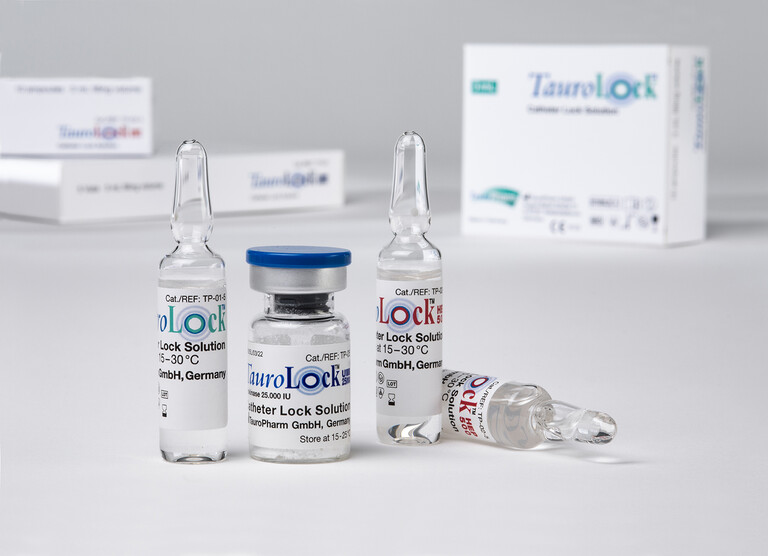
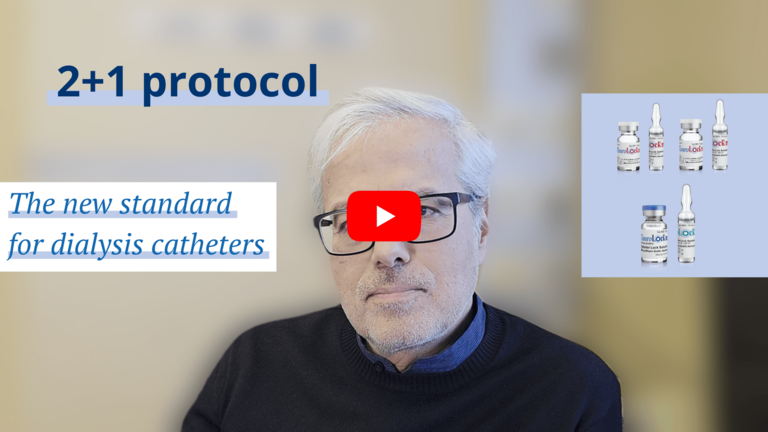
За решаването на този проблем, разработихме протокола 2+1: профилактично приложение на TauroLock™-HEP500 два пъти седмично и TauroLock™-U25.000 веднъж седмично. Доказано е, че този подход ефективно предотвратява не само катетър-свързаните инфекции, но и оклузията, тромбозата и дисфункцията на катетъра.
Препоръчано от експерти
Проф. д-р Гюркан Сенголге е нефролог с над 20 години опит.
Той въвежда протокола 2+1 като стандарт на лечение в Университетската клиника по нефрология във Виена. Това води до значително намаляване на катетър-свързаните усложнения:
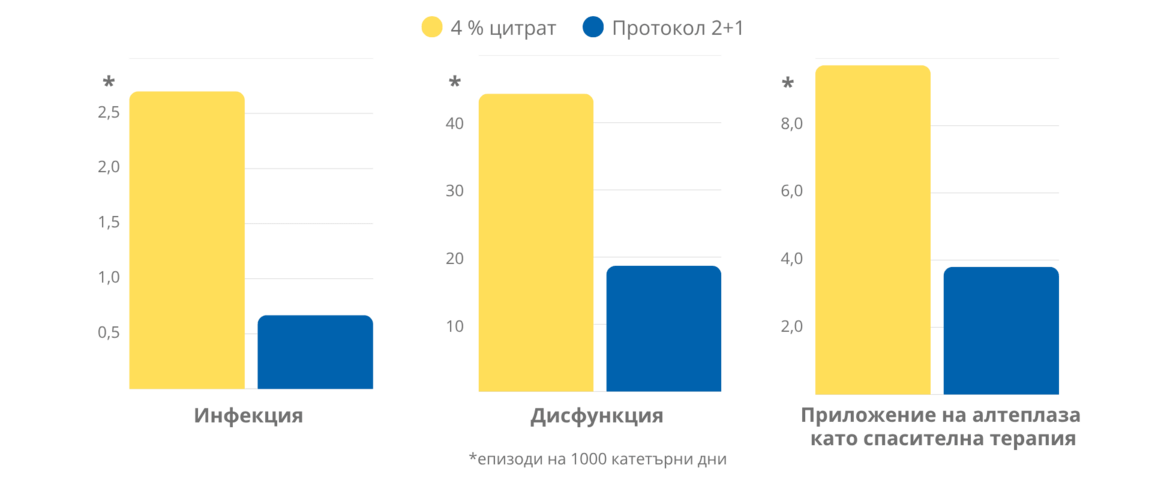
- 75 % по-малко инфекции (до 0,7 епизода на инфекция 1000 катетърни дни)
- 60 % по-малко дисфункции
- 50 % по-малко необходимост от приложение на алтеплаза като спасителна терапия.
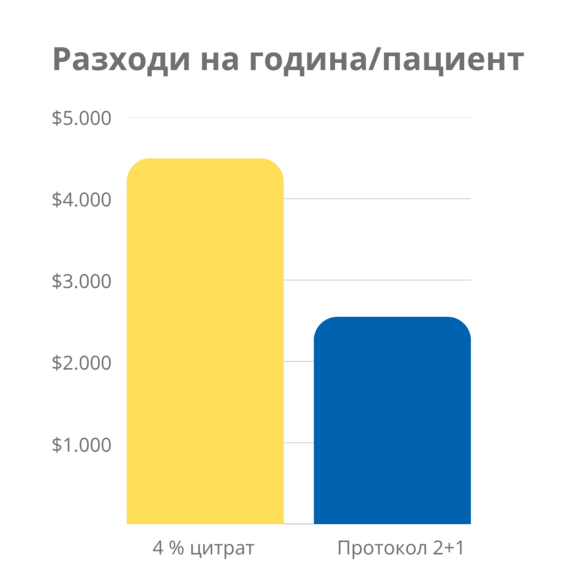
Общите разходи за лечение са намалени с 43 %. Същевременно качеството на живот на пациентите значително се подобрява. Те се нуждаят от по-малко интервенции, по-малко хоспитализации и по-рядка смяна на катетри.
Background: Taurolidine citrate with heparin (TauroLock™/Hep) is a promising central venous catheter lock solution. Despite its universal use among our hemodialysis patients, the prevalence of catheter malfunction was high. We aimed to compare TauroLock™/Hep and taurolidine citrate with urokinase (TauroLock™/U) as a catheter lock solution in order to identify whether either solution could reduce catheter-related dysfunction.
Methods: In this prospective, randomized, controlled trial, patients were randomized to receive either TauroLock™/Hep or TauroLock™/U and were followed for 6 months. Episodes of acute catheter thrombosis, requirement of recombinant tissue plasminogen activator (rt-PA) and incidence of catheter-related blood stream infection (CRBSI) were recorded, along with dialysis adequacy (Kt/V), blood flow rates (BFRs) and adverse events.
Results: There were 93 inclusions (85 patients) in the TauroLock™/Hep group and 84 inclusions in the TauroLock™/U group (79 patients). Three catheters were removed in the TauroLock™/Hep group because of acute thrombosis, while no catheter was removed for the same reason in the TauroLock™/U group. The total number of all-causes catheter exchange (acute thrombosis and CRBSI) was significantly lower in TauroLock™/U group (P=0.028). rt-PA was used significantly less often in the TauroLock™/U group than in the TauroLock™/Hep group (P=0.006). Moreover, higher BFR and Kt/V were noted in the TauroLock™/U group than in the TauroLock™/Hep group, although the differences were not uniformly significant.
Conclusion: TauroLock™/U is a safe and effective tunneled dialysis catheter lock solution, with a low rate of catheter exchange.
Catheter-related infections and dysfunction are the main catheter complications causing morbidity and mortality in hemodialysis patients. However, there are no consistent data for the choice of catheter lock solutions for tunneled hemodialysis lines. In this prospective, multicenter, randomized, controlled trial, two lock regimens using three commercial catheter lock solutions were compared in 106 hemodialysis patients with a newly inserted tunneled central catheter. In the taurolidine group, TauroLock™-Hep500 was used twice per week and TauroLock™-U25,000 once a week. In the citrate group, a four percent citrate solution was used after each dialysis. Both groups were compared regarding catheter-related infections, catheter dysfunction, and costs. Over a period of 15,690 catheter days, six catheter-related infections occurred in six of 52 patients in the taurolidine group, but 18 occurred in 13 of 54 patients in the citrate group, corresponding to 0.67 and 2.7 episodes of catheter-related infections per 1000 catheter days, respectively (Incidence Rate Ratio 0.25, 95% confidence interval, 0.09 to 0.63). Catheter dysfunction rates were significantly lower in the taurolidine group (18.7 vs. 44.3/1000 catheter days) and alteplase rescue significantly more frequent in the citrate group (9.8 vs. 3.8/1000 catheter days). These differences provided significant catheter-related cost savings of 43% in the taurolidine group vs. citrate group when overall expenses per patient and year were compared. Thus, use of taurolidine-based catheter lock solutions containing heparin and urokinase significantly reduced complications related to tunneled hemodialysis catheters when compared to four percent citrate solution and was overall more cost-efficient.
…Basically, a value as low as possible should be aimed at. Blocking with antibacterial lock solutions may be part of measures against overly high bloodstream infections in catheter patients (Cat. IB)…taurolidine and gentamicin exert only antimicrobial effectiveness…Citrate solutions show … – in higher concentrations – at least partial antimicrobial properties, which is – however – insufficient against Staph. aureus.
…An additional option is the intermittent (once weekly) use of urokinase in the lock solution (Cat IB)….
За лични запитвания, можете също да се свържете с нас по телефона или по имейл.
Нашите международни дистрибутори, базирани в повече от 50 страни, се радват да предложат подкрепа, възможно най-бързо.