


“You have to give life a chance”
Patient Yvonne on metal concerts and rocket moments
What does TauroLock™ have to do with heavy metal? Yvonne doesn’t need to think twice about that. For her, antimicrobial protection is essential for doing the things she loves – from family holidays to music festivals. Yvonne has been dependent on parenteral nutrition for 10 years, but she doesn’t let it stop her from anything. On the contrary: For her, the diagnosis marked the start of a “better, more mindful life”. In this interview, she told us how she got to this point and what advice she would give to other patients.
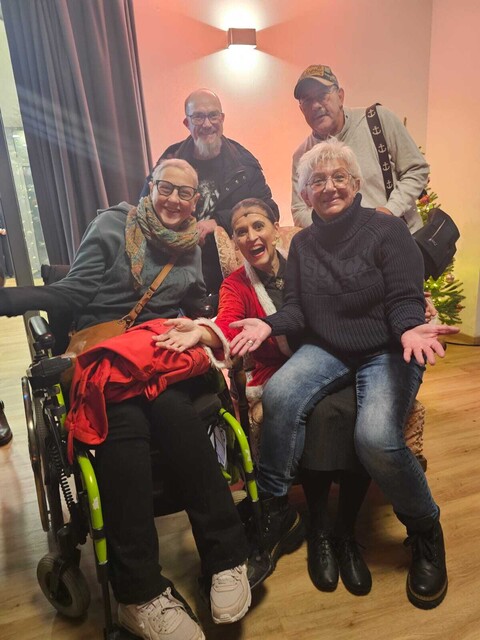
How long have you been living with parenteral nutrition and how did it come about?
I have a genetic defect called familial adenomatous polyposis. With this condition, polyps form in the bowel, which can mutate into malignant tumours over time. I was diagnosed at 16 and three years later I had to have my large bowel removed. After that, I was actually able to live without parenteral nutrition, and that went well for almost 20 years. In my mid-30s however, I had two surgeries to shorten my small bowel. A few months later, I suffered multiple organ failure. To this day, we don’t know why exactly. I ended up in a coma for several weeks with a survival chance of three to seven per cent. So it was quite a miracle that I even survived. But as a result of this organ failure, my small intestine died off completely. Now I’m left with just 60 to 70 cm. When I came out of the coma, they told me: “We need to insert a port.” I’ve been living with parenteral nutrition ever since.
That’s an extreme change, from one moment to the next. How did you cope with it?
Yes, it was quite a shock at first. Until then, I didn’t even know what a port was. And it took me a while to realise that this parenteral nutrition thing is ‘forever’. You have to search and find your way into it. Fortunately, the team at the hospital did a lot to make me feel safe right from the start. And I have a strong family who stand by me and support me.
What I struggled with initially was being told all the things I couldn’t do anymore. In the first few months at home, I couldn’t even leave my flat and it sometimes felt like a prison. But then I decided: I will fight my way back into life. Step by step.
That must have been a long journey. What gave you the strength to carry on?
My two cats were a really important milestone. I got them about a year after the coma. There was this one moment when I brought them into my flat for the first time and one of them immediately snuggled up against my chest, right by my neck. That was like the final switch being flipped, the last piece of the jigsaw. That’s when I knew: “Now I’m whole again.” My cats are still my main source of support in everyday life, like balm for the soul. One of them is now my little care assistant. He senses when it’s time for PN, and then he keeps rubbing up against my legs until I connect the drip.
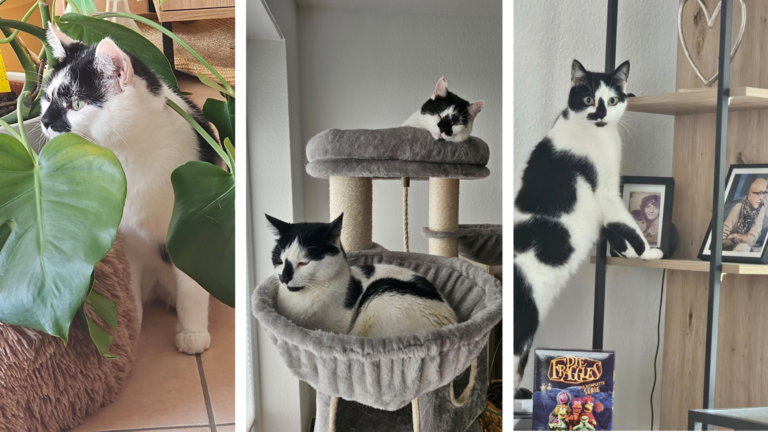
Someone’s looking after you well! What’s your everyday life like with PN? Do you have a fixed daily routine?
The PN runs for 12 hours a day, mostly at night. My body got so used to it that it automatically winds down when I connect the drip. So I usually fall asleep easily whilst on PN. When I get up, I disconnect the drip, have a shower, and get ready for the day. After that, I’ve got enough energy to manage several appointments in a row. Shopping, gardening, whatever’s on the agenda. But it always depends on how I’m feeling that day. I just have to see how much I can manage and when it becomes too much. My care provider from confido Care comes once a week to change the port needle. Otherwise, I take care of the PN and catheter managenemt myself, including daily locking with TauroLock™. I prefer to do it all by myself, that way I have full control and don’t have to worry about mistakes being made or hygiene standards not being met.
Have you had any negative experiences in that regard?
Yes, unfortunately. My port has had to be replaced seven times so far – due to incidents that could have been prevented.
For example, I once got an infection because the carer didn’t wear a face mask when changing the port needle and had been smoking beforehand.
On another occasion, the port became infected because the nurse accidentally punctured the catheter from the inside.
There were also unpleasant situations during hospital stays. When my port was removed due to sepsis and a central-venous catheter (CVC) was inserted in my neck, I realised that something was wrong with the CVC after a few weeks. But the staff didn’t take my concerns seriously.
At first, the nurse wanted to give me an antibiotic injection, which I refused. The doctor then tried to flush it with saline, but it squirted everywhere except into the catheter. The final diagnosis: I’d been right all along – the access was damaged and had to be replaced.
I find this sort of behaviour – not taking patients seriously at all – completely irresponsible. Patients at the very beginning of their diagnosis are thus burdened with a fear that is totally unnecessary.
"Without TauroLock™, much of what I’ve experienced over the last few years wouldn’t have been possible."
What advice would you give to those patients at the very beginning?
First and foremost: They need to learn to stand up for themselves. Don’t accept hygiene standards not being met. I’ve now reached the point where I know my body better than my doctor. I know what I need, and I make sure to say so. The port is a one-way street – any germs that get in won’t come out again. That’s why I don’t compromise when it comes to catheter care. Keeping everything 100 % sterile and locking with TauroLock™ every single day, without exception. For me, it’s just as much a part of my routine as hand sanitiser or a face mask. If I don’t use TauroLock™, I feel unsafe. In my opinion, it should be available to everyone as part of basic healthcare. Without TauroLock™, much of what I’ve experienced over the last few years wouldn’t have been possible at all.
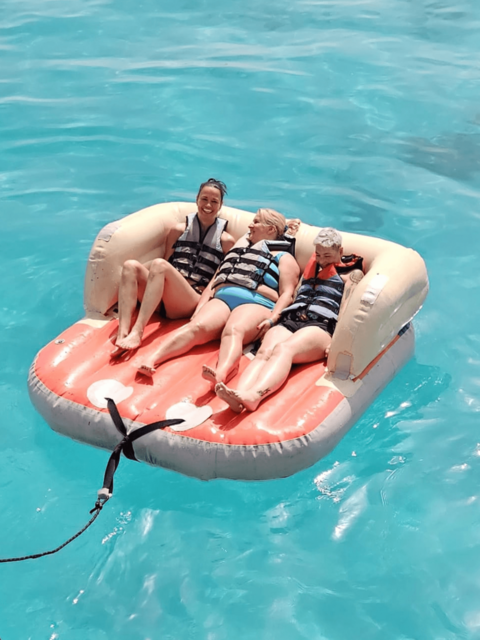
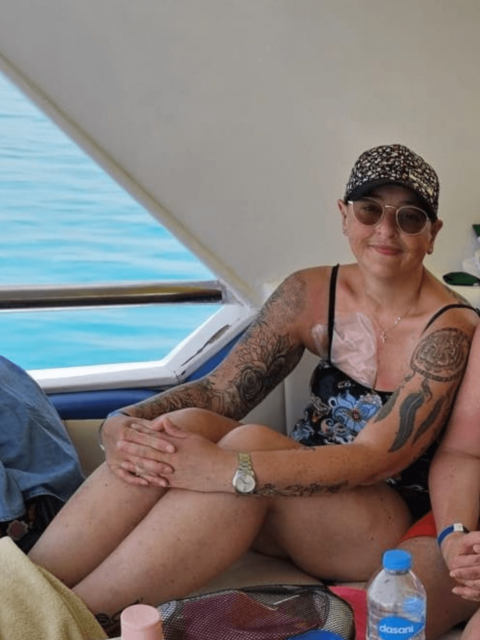
What sort of experiences are you talking about?
I love going out, being active around people and trying new things. Going on holiday with my family, going for a swim – that’s pure joy for me. And you can do that with a port too, as long as you take proper precautions. When I go swimming, for example, I wear a waterproof plaster (Exit-Pocket), and apart from that, TauroLock™ protects me round the clock anyway.
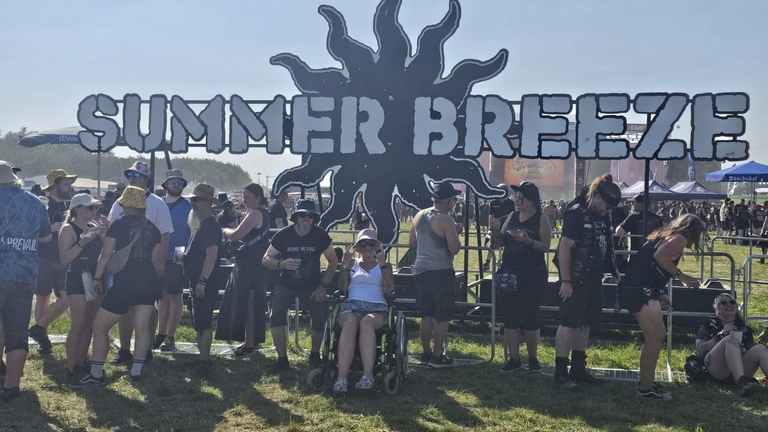
I also absolutely love going to concerts. I take my wheelchair with me – otherwise it would be too tiring for me. Sometimes, that comes in handy too, when there are no reserved seats. Last year, I went to a festival for the first time, the Summer Breeze. Everything went smoothly, thanks to the support of my care provider. It was a lifelong dream come true. I even went backstage and up on the stage. Everyone around me pitched in to help, carrying my wheelchair up and down and supporting me on the stairs. And then we celebrated the music together. In moments like that, it doesn’t matter whether you’re sick or healthy: Everyone shares the same feeling. It was so wonderful that I immediately booked my ticket for the next year.
Sounds like you’re really enjoying life to the fullest?
Absolutely! I’ve been living with PN for 10 years now and can say with complete certainty that I don’t miss out on anything. In many ways, I live more mindful and better today than I did back then without PN. Because now I experience everything much more intensely. Moments that might be just a little thing, a spark, for others are like a rocket, a firework, for me.
That’s why I want to encourage other patients. I would have been glad if I’d had more help at the start – role models to guide me. If I’d listened to my doctors back then, I wouldn’t be doing or experiencing any of the things I do today. I don’t want to be told how I have to to look or feel as a sick person. I can be sick and still go shopping at the supermarket in a good mood, go to metal concerts, and fly off on holiday.
Getting back up again and again, trying anew – that’s my motto. If you take 20 steps forward and 10 back, you’ll still be 10 steps further on in the end. There’s always a glimmer of hope. You just have to give life a chance.