


2+1 protocol
The new standard for dialysis catheters
Central-venous catheters carry a high risk of complications for dialysis patients. But in many cases, this type of vascular access is the only and/or best option.
To solve this problem, we have developed the 2+1 protocol: Prophylactic locking with TauroLock™-HEP500 two times weekly and TauroLock™-U25.000 once weekly. This formula has proven to effectively prevent not only catheter-related infection, but also occlusion, thrombosis, and dysfunction.
Recommended by experts
Prof. Dr. Gürkan Sengölge is a nephrologist with over 20 years of experience.
He implemented the 2+1 protocol as the standard of care at the University Clinic for Nephrology in Vienna. This led to a significant decrease of catheter-related complications:
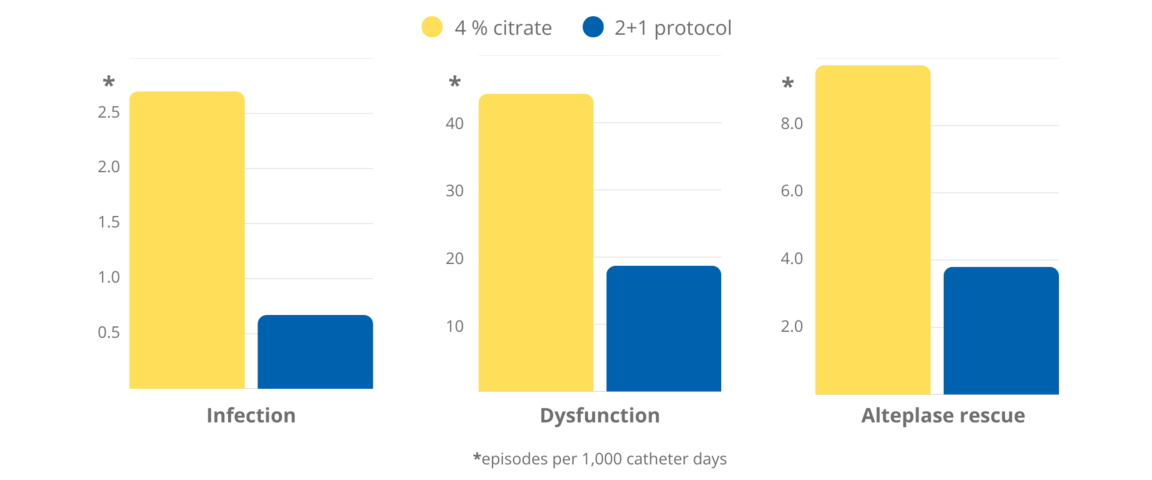
- 75 % less infections (down to 0.7 infection episodes per 1,000 catheter days)
- 60 % less dysfunction
- 50 % less need for alteplase rescue.
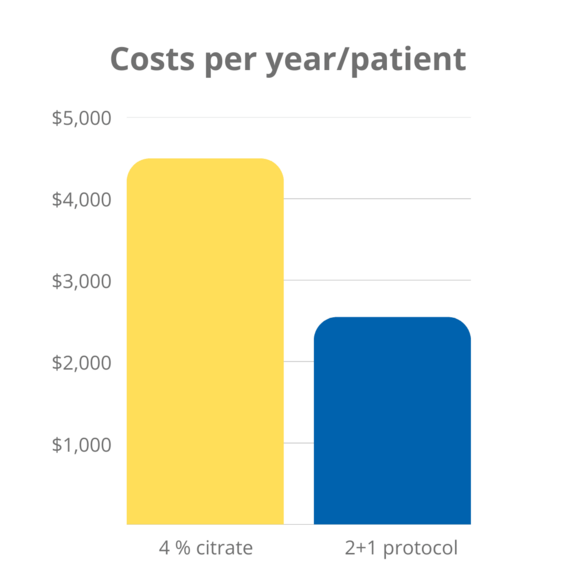
The total treatment costs were reduced by 43 %. At the same time, the patients’ quality of life significantly improved. They required less interventions, less hospitalisations, and less catheter exchanges.
Background: Taurolidine citrate with heparin (TauroLock™/Hep) is a promising central venous catheter lock solution. Despite its universal use among our hemodialysis patients, the prevalence of catheter malfunction was high. We aimed to compare TauroLock™/Hep and taurolidine citrate with urokinase (TauroLock™/U) as a catheter lock solution in order to identify whether either solution could reduce catheter-related dysfunction.
Methods: In this prospective, randomized, controlled trial, patients were randomized to receive either TauroLock™/Hep or TauroLock™/U and were followed for 6 months. Episodes of acute catheter thrombosis, requirement of recombinant tissue plasminogen activator (rt-PA) and incidence of catheter-related blood stream infection (CRBSI) were recorded, along with dialysis adequacy (Kt/V), blood flow rates (BFRs) and adverse events.
Results: There were 93 inclusions (85 patients) in the TauroLock™/Hep group and 84 inclusions in the TauroLock™/U group (79 patients). Three catheters were removed in the TauroLock™/Hep group because of acute thrombosis, while no catheter was removed for the same reason in the TauroLock™/U group. The total number of all-causes catheter exchange (acute thrombosis and CRBSI) was significantly lower in TauroLock™/U group (P=0.028). rt-PA was used significantly less often in the TauroLock™/U group than in the TauroLock™/Hep group (P=0.006). Moreover, higher BFR and Kt/V were noted in the TauroLock™/U group than in the TauroLock™/Hep group, although the differences were not uniformly significant.
Conclusion: TauroLock™/U is a safe and effective tunneled dialysis catheter lock solution, with a low rate of catheter exchange.
Catheter-related infections and dysfunction are the main catheter complications causing morbidity and mortality in hemodialysis patients. However, there are no consistent data for the choice of catheter lock solutions for tunneled hemodialysis lines. In this prospective, multicenter, randomized, controlled trial, two lock regimens using three commercial catheter lock solutions were compared in 106 hemodialysis patients with a newly inserted tunneled central catheter. In the taurolidine group, TauroLock™-Hep500 was used twice per week and TauroLock™-U25,000 once a week. In the citrate group, a four percent citrate solution was used after each dialysis. Both groups were compared regarding catheter-related infections, catheter dysfunction, and costs. Over a period of 15,690 catheter days, six catheter-related infections occurred in six of 52 patients in the taurolidine group, but 18 occurred in 13 of 54 patients in the citrate group, corresponding to 0.67 and 2.7 episodes of catheter-related infections per 1000 catheter days, respectively (Incidence Rate Ratio 0.25, 95% confidence interval, 0.09 to 0.63). Catheter dysfunction rates were significantly lower in the taurolidine group (18.7 vs. 44.3/1000 catheter days) and alteplase rescue significantly more frequent in the citrate group (9.8 vs. 3.8/1000 catheter days). These differences provided significant catheter-related cost savings of 43% in the taurolidine group vs. citrate group when overall expenses per patient and year were compared. Thus, use of taurolidine-based catheter lock solutions containing heparin and urokinase significantly reduced complications related to tunneled hemodialysis catheters when compared to four percent citrate solution and was overall more cost-efficient.
…Basically, a value as low as possible should be aimed at. Blocking with antibacterial lock solutions may be part of measures against overly high bloodstream infections in catheter patients (Cat. IB)…taurolidine and gentamicin exert only antimicrobial effectiveness…Citrate solutions show … – in higher concentrations – at least partial antimicrobial properties, which is – however – insufficient against Staph. aureus.
…An additional option is the intermittent (once weekly) use of urokinase in the lock solution (Cat IB)….
For personal inquiries, feel free to contact us via phone or email.
Our international distributors based in more than 50 countries will answer your requests ASAP.