


Protocole 2+1
La nouvelle norme pour les cathéters de dialyse
Les cathéters veineux centraux présentent un risque élevé de complications pour les patients dialysés. Mais dans de nombreux cas, ce type d'accès vasculaire est la seule et/ou la meilleure option.
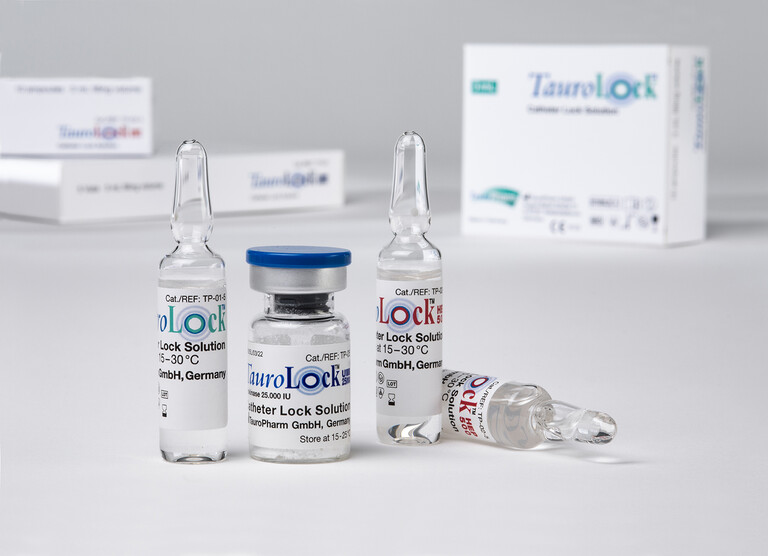
Pour résoudre ce problème, nous avons développé le protocole 2+1 : verrouillage prophylactique avec TauroLock™-HEP500 deux fois par semaine et TauroLock™-U25.000 une fois par semaine. Cette formule a prouvé son efficacité non seulement pour prévenir les infections liées aux cathéters, mais aussi les occlusions, les thromboses et les dysfonctionnements.
Recommandé par les experts
Le professeur Gürkan Sengölge est un néphrologue qui compte plus de 20 ans d'expérience.
Il a mis en place le protocole 2+1 comme norme de soins à la clinique universitaire de néphrologie de Vienne. Cela a conduit à une diminution significative des complications liées aux cathéters :
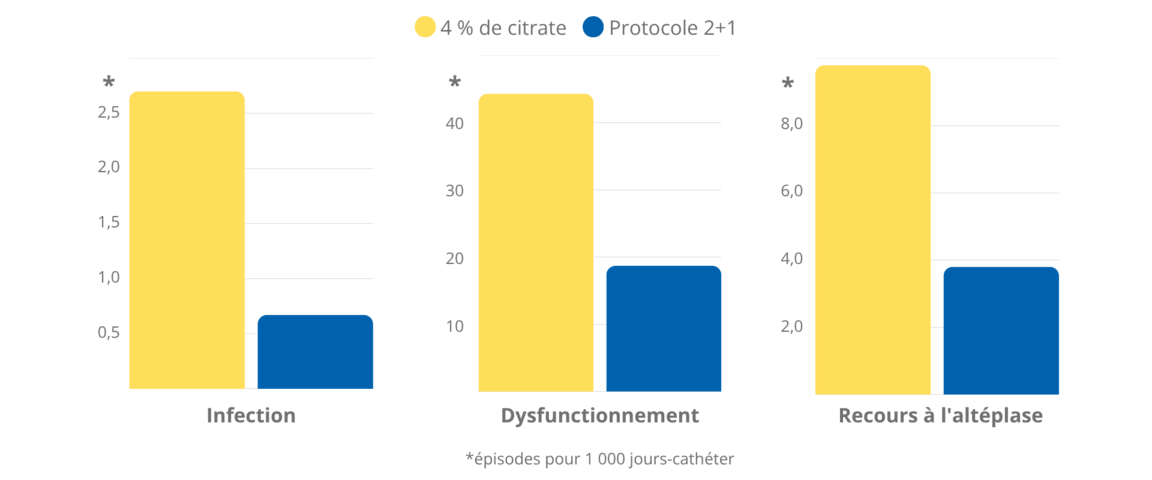
- 75 % d‘infections en moins (jusqu'à 0,7 épisode infectieux pour 1 000 jours-cathéter)
- 60 % de dysfonctionnements en moins
- 50 % de recours à altéplase en moins.
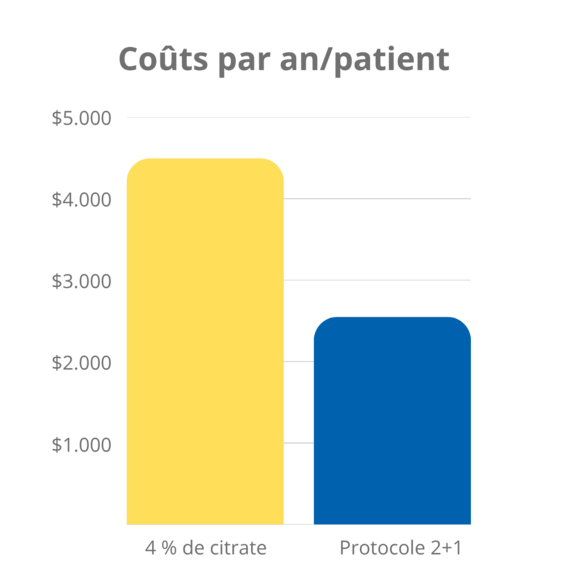
Les coûts de traitements totaux ont été réduits de 43 %. Parallèlement, la qualité de vie des patients s'est considérablement améliorée. Ils ont nécessité moins d'interventions, moins d'hospitalisations et moins de changements de cathéter.
Background: Taurolidine citrate with heparin (TauroLock™/Hep) is a promising central venous catheter lock solution. Despite its universal use among our hemodialysis patients, the prevalence of catheter malfunction was high. We aimed to compare TauroLock™/Hep and taurolidine citrate with urokinase (TauroLock™/U) as a catheter lock solution in order to identify whether either solution could reduce catheter-related dysfunction.
Methods: In this prospective, randomized, controlled trial, patients were randomized to receive either TauroLock™/Hep or TauroLock™/U and were followed for 6 months. Episodes of acute catheter thrombosis, requirement of recombinant tissue plasminogen activator (rt-PA) and incidence of catheter-related blood stream infection (CRBSI) were recorded, along with dialysis adequacy (Kt/V), blood flow rates (BFRs) and adverse events.
Results: There were 93 inclusions (85 patients) in the TauroLock™/Hep group and 84 inclusions in the TauroLock™/U group (79 patients). Three catheters were removed in the TauroLock™/Hep group because of acute thrombosis, while no catheter was removed for the same reason in the TauroLock™/U group. The total number of all-causes catheter exchange (acute thrombosis and CRBSI) was significantly lower in TauroLock™/U group (P=0.028). rt-PA was used significantly less often in the TauroLock™/U group than in the TauroLock™/Hep group (P=0.006). Moreover, higher BFR and Kt/V were noted in the TauroLock™/U group than in the TauroLock™/Hep group, although the differences were not uniformly significant.
Conclusion: TauroLock™/U is a safe and effective tunneled dialysis catheter lock solution, with a low rate of catheter exchange.
Catheter-related infections and dysfunction are the main catheter complications causing morbidity and mortality in hemodialysis patients. However, there are no consistent data for the choice of catheter lock solutions for tunneled hemodialysis lines. In this prospective, multicenter, randomized, controlled trial, two lock regimens using three commercial catheter lock solutions were compared in 106 hemodialysis patients with a newly inserted tunneled central catheter. In the taurolidine group, TauroLock™-Hep500 was used twice per week and TauroLock™-U25,000 once a week. In the citrate group, a four percent citrate solution was used after each dialysis. Both groups were compared regarding catheter-related infections, catheter dysfunction, and costs. Over a period of 15,690 catheter days, six catheter-related infections occurred in six of 52 patients in the taurolidine group, but 18 occurred in 13 of 54 patients in the citrate group, corresponding to 0.67 and 2.7 episodes of catheter-related infections per 1000 catheter days, respectively (Incidence Rate Ratio 0.25, 95% confidence interval, 0.09 to 0.63). Catheter dysfunction rates were significantly lower in the taurolidine group (18.7 vs. 44.3/1000 catheter days) and alteplase rescue significantly more frequent in the citrate group (9.8 vs. 3.8/1000 catheter days). These differences provided significant catheter-related cost savings of 43% in the taurolidine group vs. citrate group when overall expenses per patient and year were compared. Thus, use of taurolidine-based catheter lock solutions containing heparin and urokinase significantly reduced complications related to tunneled hemodialysis catheters when compared to four percent citrate solution and was overall more cost-efficient.
...En principe, il faut viser une valeur aussi basse que possible. Le verrouillage avec des solutions verrous antibactériennes peut faire partie des mesures contre les infections sanguines trop élevées chez les patients porteurs de cathéters (Cat. IB)...la taurolidine et la gentamicine n'exercent qu'une efficacité antimicrobienne...Les solutions de citrate présentent... - à des concentrations plus élevées - des propriétés antimicrobiennes au moins partielles, qui sont toutefois insuffisantes contre Staph. aureus.
...Une option supplémentaire est l'utilisation intermittente (une fois par semaine) de l'urokinase dans la solution verrou (Cat IB)....
Pour toute demande personnelle, n'hésitez pas à nous contacter par téléphone ou par e-mail.
Nos distributeurs internationaux basés dans plus de 50 pays répondront à vos demandes dans les plus brefs délais.